

”War is good for business.”
—The 34th Rule of Acquisition1
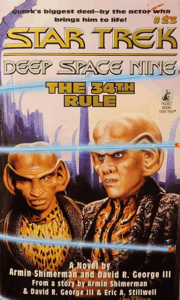
In today’s episode, when the Grand Nagus puts an Orb of the Prophets on eBay, the Bajorans’ max bid gets auto-beaten. But when they respond by booting all Ferengi from their space, Quark and Rom spend their summer at camp—and it ain’t Anawanna. How good was Odo in keyboarding class? Who, what, or where is Rokeg? And why do I have to wait six to eight weeks for my Space Etsy order to arrive? All this and more in The 34th Rule, the book that teases us with the Nechayev tea.
The 34th Rule
Authors: Armin Shimerman, David R. George III
Pages: 425
Published: January 1999
Timeline: Just after “Bar Association” (4×15)
Prerequisites: None, outside of basic familiarity with some characters that don’t start getting more developed until the middle of the series
The Ferengi are an intriguing piece of the Star Trek puzzle, both because of what they are and what they reveal about us. Insofar as all alien races in Star Trek can be argued to be a manifestation of something humans wish to grapple with about themselves, they represent our greed and the capitalistic tendencies of the last forty years or so and counting. But they also have a way of quickly putting the lie to our high-minded aspirations toward enlightened treatment of all races. It is this latter quality that Armin Shimerman, the actor who played Quark for all seven seasons of Star Trek: Deep Space Nine from 1993 to 1999, tries to shine a light on in The 34th Rule. But it gets complicated.
The Ferengi were introduced in the first season of Star Trek: The Next Generation as the new intergalactic menace. Their name derives from firangi, a Persian variation of farang, a term common in South Asia and Ethiopia that referred specifically to the Franks and more generally to European foreigners, meaning the Ferengi were most likely originally intended to be roughly equivalent to European colonialist merchants. Unfortunately, the Ferengi never quite emerged as the threat the TNG writers hoped they would, so they got shelved for much of the show’s run, returning to nearly universal derision every time they did dare to poke their ears out for an episode. They fared somewhat better on Deep Space Nine due to the generally more thoughtful nature of that show’s writing staff, but there, too, it isn’t so simple.
For whatever reason, nearly all major Ferengi characters have been played by Jewish actors, which gives them a sort of unique texture among Trek aliens. That said, it would be misguided at best and, worse, facile and problematic (though I have heard it said from time to time) to claim that the Ferengi are the Jews of Star Trek. Even putting aside the more baldly antisemitic dangers of the proposition, it runs into a broader problem that the Ferengi have, which is that some of the aspects that people might want to map onto them tend to map better onto another race. Part of that comes from how the Ferengi were developed over the course of Deep Space Nine, away from TNG’s rapacious pirate depiction and into a culture that, while ruthlessly legalistic, doesn’t consist of warmongers or look favorably on war in general. That sort of inclines me to believe they’re better classified as their own thing, and that the Jewish label is better applied elsewhere or not at all.
Shimerman’s take is that the Ferengi represent the outcast. At the Star Trek Mission New York convention in 2016, he gave this answer when asked about fan readings and interpretations cast members had heard:
In America, people ask ‘Do the Ferengi represent Jews?’ In England, they ask ‘Do the Ferengi represent the Irish?’ In Australia, they ask if the Ferengi represent the Chinese… The Ferengi represent the outcast… it’s the person who lives among us that we don’t fully understand.
This is a nice answer, but I think it is kind of cagey. It feels more like an answer meant to placate an audience than what I suspect Shimerman actually thinks. Now, it’s definitely at least a little dicey to act like I know what another person is thinking in their heart of hearts, but I do think that Shimerman does believe the Ferengi do, to at least some extent, represent (or maybe reflect?) Jews, Jewishness, etc.—and the reason I think that is that he would not have written a novel where Quark and Rom get thrown in a concentration camp if he didn’t.
Yeah. This book is, uh, pretty wild!
So now finally the actual story: Grand Nagus Zek has purchased the ninth Orb of the Prophets, the Orb of Wisdom, from a Cardassian contact, and is willing to sell it to the highest bidder, including Bajor, if it happens to be them. But it doesn’t, womp womp, so he shuts them out of the subsequent stages of the auction. In retaliation, Bajor gives the Nagus three days to reinstate them in the bidding, or else they’ll evict all Ferengi from Bajoran space. Three days pass and Zek doesn’t budge, so the Bajorans make good on their threat. Quark makes an admirable attempt to stay on the station despite the edict, and is abetted by Sisko and Odo as much as they’re able, but the Bajoran militia roots him out, and he, Rom, and a few other Ferengi are taken to a camp called Gallitep, run with a dark-matter fist by a psycho named Colonel Mitra.
But the Quark/Rom scenes actually take up comparatively little of the book. This is a Sisko story as much as it is a Ferengi tale—often more so, in fact, as we spend a lot of time with him as he examines his own prejudices toward the Ferengi and tries to talk sense into First Minister Shakaar, who is fairly easily whipped up into a warmongering frenzy by Kai Winn. Sisko and Odo do the most self-examining, and the book is quite effective at tapping into those feelings that bubble up when one has to face the prospect of bowing up to their own major institutions. Kira holds Quark’s feet to the fire about his claimed inability to change the Grand Nagus’s mind, and his rationalizations are true to life in the way he comes across as very reasonable in his self-defense while simultaneously giving the reader the impression he could be doing a lot more than he says he could. It’s very effective at provoking disquieting feelings about whether one is doing all they can to resist their own major institutions.
Actually, though, it might be more accurate to say Kira plunges Quark’s feet straight into the fire. Yes, this is one of the many unfortunate stories where the ugliness to which the Bajoran heart seems to succumb all too readily rears its ugly head. Kira in particular is really nasty in this book; at one point, Dax even pulls her aside and basically stops just short of asking her “What the actual f___ is wrong with you?” She never really adequately atones for this behavior either, just sort of sheepishly shrugging about itby the end. And though Kai Winn is easy enough to see as an eager warmonger, it’s sad to see Shakaar get pulled along so easily in her current. Books where Bajorans act like this always get me a little down.
This book is also long in a way that suggests that no one was about to tell Armin Shimerman that he had to kill any of his darlings. Owing to his predilection toward classic literature, he does write in a more properly literary fashion than your average Star Trek paperback writer, which is refreshing, but some passages go on a bit. He’ll fill pages and pages of small-print setup before characters actually start talking. Complaining about this makes me feel like a tool because I feel like I’ve also complained about the wee-wonky pacing of the quicker, breezier books in the past, but there’s no denying I found this one pretty slow in a lot of places.
I know the book is supposed to get you thinking about how the Ferengi are regularly treated like second-class citizens, but I nevertheless found a lot of the comparisons advanced by Shimerman hard to swallow. I’m definitely on board with the idea that they deserve more dignity and respect than they ordinarily receive, but every time I’m faced with somehow comparing their plight to Jackie Robinson’s or equating their suffering in Gallitep to a place like Auschwitz or Abu Ghraib, I falter. I don’t think the Ferengi have enough of the kind of strength necessary to support those kinds of analogues without a lot of internal squirming. If you’re going to ask me to be more mindful of how certain minorities are treated, I’d rather just read narratives about those minorities and not try to pretend that a fictional race of big-eared aliens can serve as any kind of meaningful stand-in for them. I guess I believe there are some jobs allegory is just too big for.
The hardest hurdle for me to clear, however, is that the events of the book are a lot for the characters to come back from. Quark and Rom being in a concentration camp and implicitly bouncing back in the future is next-level episodic trauma erasure. This is the Locutus problem times, like, a thousand. Also, in terms of Star Trek morality, if I’m the Federation and I learn about a guy like Colonel Mitra and am agog at how a guy like that slipped through the system, Bajor isn’t getting into the Federation for at least a generation. Like, do not even bother to submit an application. We will make you watch while we use it as toilet paper.
I know this book has a solid reputation, but it got me in my own head way too much to call it strong without a lot of qualifications and reservations. Colonel Mitra is a brutal antagonist, but it’s an awfully long-winded yarn, and I think it asks a lot of the Ferengi. Not that they need to stay in their comic relief lane or anything, but I think it’s possible to create effective drama involving them that doesn’t put so much symbolic weight on their shoulders. That said, it was at least good enough for open the doors for other Trek actors to try their hand at writing novels—an effort that soon resulted in A Stitch in Time. Maybe not a stretch to say the most beloved Star Trek novel of all time? In any event, I’m sure at my current pace, we’ll get to it in 2058.
MVP & LVP
- My MVP for this book is Rom. Not sure if I’m on record as saying so, but I’m pretty sure Rom is my favorite character in all of Star Trek? I will never stop finding it heartwarming how devoted he is to his brother, even after all Quark says to him, says about him, does to him, etc., and how he risks going to a concentration camp just to stay beside him rather than finding his own way off the station when the edict comes down. It was also pretty cool when he shoved a guy so hard that the guy hit his head and died. (It’s okay, the guy deserved it.)
- “The guy” is in fact my LVP for this book. His name is Wyte, and he’s one of Mitra’s lackeys, the exact kind of stupid sadist with no interior life who responds all to easily to the clarion call of fascism. Living where I do, I know too many guys like Wyte. (An uncomfortable aptronym, that.)
Stray Bits
- Right off the bat, I gotta apologize for how long it took me to get this review out the door. This semester has been crazy. Hopefully summer will prove more productive.
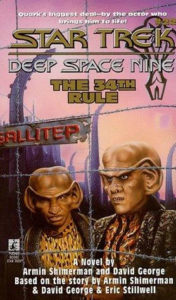
- Cover Art Corner: I did not realize until deep into writing this review that there is actually an alternate cover for this book (seen at right). As you can see, there are some differing details, like a barbed-wire fence instead of a laser one, a sign that reads GALLITEP, and more obvious signs that the camp is of Cardassian design and origin.
- This book pays a lot of neat attention to quirks of alien biology. At the beginning, Quark’s ears can pick up Odo’s internal liquid flow, so he knows when he’s coming, and much later on, Odo adds more fingers to his hands to type faster. I don’t know if the latter actually works as well in practice as a writer imagines it in their mind, but the visual I have of it in my head looks pretty cool.
- Sisko, p. 52: “‘What would you say,’ he whispered, apparently very serious, ‘if I told you that I once saw Admiral Nechayev dancing in a nightclub on Mars?’” I’d say PICS OR IT DIDN’T HAPPEN BENNY
- Janeway: “Delete the wife.” Sisko: “Delete the fan.” (103)
- ”I tend to avoid dishes that have the word blood in them.” / “Well, then I guess you don’t want to know what the word rokeg means.” Have heard of the delicacy, of course, but decided to look it up after seeing this—and it’s not in the Klingon dictionary! Maybe it’s named after its region of origin? the person who first made it?
- “The dolls—the entire shipment, in fact—would normally have been loaded onto the ship with the use of a transporter, but since all of the items had been fashioned by hand, it was consequently necessary that they be delivered by hand. In general, when people purchased goods noteworthy because they had been handcrafted, they wanted them to remain handcrafted, not converted into energy and then reconstituted by a transporter into its initial material form; if that were acceptable, then a would-be buyer could simply create such goods by employing a replicator.” Now here’s an exciting philosophical debate. Tired: do you die when you go through the transporter? Wired: is your Beanie Baby still hand-crafted if it goes through the transporter?
- I don’t know what happened to it, but I lost my physical copy of this book somewhere between finishing reading it and finishing the review. That’s why some parts of this section don’t have an accompanying page number for their passages. It’s gotta be around my desk at school somewhere or here at home, but so far, I’m stumped.
Final Assessment
Average. I’m afraid I can’t quite get behind what I have a feeling is most likely the popular sentiment on this one. Shimerman has a lot of big ideas and a more writerly voice than one is used to seeing in these novels, but I didn’t feel like the Ferengi as we know them are quite up to the job of serving as stand-ins for the plight of certain minorities. I also think putting Quark and Rom in such a grim situation is the kind of thing you can’t just contain in a single book or episode and expect it to never have a lasting impact on them. I wouldn’t argue too hard with anyone who really enjoys this book, and I definitely admire it for taking on such heady ideas, but for me, it didn’t quite make its target.
NEXT TIME: Remembering way back Winn in The Conquered
DGCatAniSiri
Some of the pacing issues may have come as much if not more from the co-author, David R. George, because his later solo novels have a tendency towards the doorstopper in size and… I’ll just say for now that there’s a tendency towards discussing how well that style actually serves those solo novels.
But yeah, that’s one of the things that really stuck with me last time I read this – Like the part that stood out was an early scene, where the chapter opens with a mention of Kira entering the bar, and then going on for a good page and a half without even mentioning her again, and probably another page or two before actually getting down to business with her, and all of the content of those pages were filled with nothing that actually is involved in the plot or even really anything beyond painting the picture, which, if we’re reading a tie-in book to a TV show, we probably already have that solid image in our minds.
It’s something that I find comes up a lot in the DRG novels, and it is something that causes a drag on my enthusiasm to keep reading myself, in feeling that things are being moved around on the board, but stretching out how long the payoff comes so that when it finally does, it feels underwhelming because it took so long to get to the relatively small result, no matter how big the plot development might be.
I do agree, though, that the involvement of Gallitep, while clearly meant to be a horrible act, does feel like a few steps too far – given everything that we learn about the labor camps in general and Gallitep in particular, it does seem like a line too far. I mean, one would hope that, in our world, even discussing the idea of reopening Aushwitz or the like, even in a “more humane” manner (god, I think that was actually physically painful to write…) would be something that the majority of the world would instantly turn on whoever suggested it, and it’s been decades, close to a century, since the camps were liberated. This is only about… fifteen-ish years following Gallitep’s liberation. At a minimum, it feels like any Bajoran even suggesting the idea of reopening Gallitep, let alone going through with it and operating it, would be viewed as drawing far more than a casual “are we the baddies?”
Especially when you remember that Kira and Shakaar were involved in the actual liberation of the camp, to the point that Kira was the one who begged Sisko to let her, to let a Bajoran, be the one who investigated Aamin Maritza in Duet because he’d been at Gallitep.
Using Gallitep and sending Quark and Rom there may have served this story, the parallel that was being established, but it does seem like the Bajorans – not just the species as a whole but even the characters who we are supposed to consider the good guys, by not immediately standing against this act – are made to cross a line that it’s not really acknowledged they’ve crossed, as well as inflicted trauma on Quark and Rom that would definitely have more lasting consequences than the novel really lingers on.
Fun casting fact since you mentioned Camp Anawana – the camp counselor is played by the actor who would portray Seven’s father in Dark Frontier.
jess
I did not realize Gallitep was actually (mentioned) in the show and tied specifically to Kira in “Duet”. Yeah, in that case, that makes things work even less than I’m suggesting here.
mastadge
So glad to see you back. Yeah, I loved this book when it came out and have been afraid to revisit for fear of finding it more problematic.
As for the length, I think you’ll find this may be a co-author thing — David R George has some chops but rarely uses one word if he thinks he can get away with turning it into a whole paragraph. I like Mission Gamma a lot but there are whole chapters of his book where you get pages of a character standing around thinking in between things happening.
Steven Mollmann
Owing to his predilection toward classic literature, he does write in a more properly literary fashion than your average Star Trek paperback writer, which is refreshing, but some passages go on a bit. He’ll fill pages and pages of small-print setup before characters actually start talking.
So excited to see this blog pop up at the top of my blogroll! My understanding (to echo the other posters) is that all the actual prose here is David R. George’s.
Craig Whitbread
Just found your page and so pleased to see someone reviewing Star Trek books in depth…and funnily enough I had just finished listening to (last week) the audio recording of this book…I have also read the novel and I enjoyed it but always wondered how would quark recover from his treatment…it was pretty brutal
Adam Goss
Welcome back. I had this book on my shelves, until I got done reading this article. I hadn’t read it yet and now I have no desire to. As a Jew, I find some of the creative decisions described here highly questionable at best. Shimerman took his responsibility of playing Quark seriously partly out of a desire to make up for the portrayal of Ferengi on TNG (the unfortunate comparisons to prejudices about Jews), as he himself played one in their debut,but I never thought he’d go so far with this idea.
I am not familiar with the writing of David George, but I have noticed that when Trek actors turn their hands to writing or co-writing Trek novels, there are often curious imperfections with the end result. Stitch in Time is guilty of this, completely skipping over (or getting wrong, I forget which) what happened between Garak and Dukat (something involving an arms merchant, according to Enabran Tane in the episode “The Die is Cast”, very surprising considering how in-depth Andrew Robinson’s notes about his character were. Shatner’s Kirk novels are self-aggrandizing. I, Q by John DeLancie fares better, but I suspect that’s because a master of Trek writing like Peter David was involved.
With Shimerman, I can only guess that this was a case of over-correction after how Ferengi were originally depicted, forgetting key details from the series i order to tell this parallel of real-world horrors against Jews and others scapegoated by societies. Using Gallitep, putting Winn and Shakaar on the same side, making Kira villainous, and having Zek sell to others when he’d ALREADY made a point of selling an Orb back just to the Bajorans, albeit at enormous expense (see the episode “Prophet Motive” which came out a year before “Bar Association”)… I’m no obsessive over canon but such choices feel very sloppy, like the history of the show and the characters is being ignored or altered to fit the story, which is never a good thing. Even lesser things yiu mention that might just be George’s fault (why would Quark be able to hear Odo’s innards when for many episodes he could never tell for sure when Odo was around in disguise, or the transporter/dolls thing makes no sense – do we start devaluing people because they HAVE been transported??) feel like poorly thought out ideas. Overall, this feels like a story that misses the trees for the forest instead of the other way around – and without the trees, you have no forest. So, yeah, sorry Armin, but I’m not reading or keeping this one. You had good intentions, but the execution is almost as poor as how the Ferengi were first depicted. 🙁