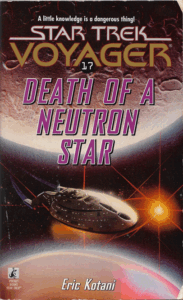
In today’s episode, Janeway once again violates the Prime Directive to help out a pair of car thieves she just met, only to learn they’re just a few hours away from the fireworks factory. But the once-in-a-lifetime celestial event takes a dark turn when she learns an evil empire plans to call their shot with it: 8-ball, corner galaxy. Is it possible to out-suck the Kazon? What’s wrong with just being nice to each other? And can anyone actually make this thing move how they want? All this and more in Death of a Neutron Star, the book that can’t say no to a good countdown.
Death of a Neutron Star
Authors: Yoji Kondo (under the pseudonym Eric Kotani), Dean Wesley Smith1
Pages: 238
Published: March 1999
Timeline: Between “Extreme Risk” (5×03) and “In the Flesh” (5×04)
Prerequisites: None
Many a Star Trek fan has endured at least one encounter of the sort where you tell someone you like Trek, and they come back with something like “Oh, Star Trek? That’s fantasy magic for babies. Let me, a big-brain genius, tell you what REAL science is.” Never mind that nobody is watching Star Trek for its meticulous attention to scientific detail (or at least, I’m not), nor that situations not currently within the purview of reality can still be aspirational. Sometimes, proponents of hard science just feel like they have to take a whack at Star Trek.
Taking on Trek has historically not gone well for authors who more typically dabble in the hard sciences. By this point in the publishing timeline, however, it was clear a kinder and gentler approach was in order. The assessment of Yoji Kondo, an astrophysicist who wrote fiction under the pseudonym Eric Kotani, by SF Encyclopedia encapsulates that site’s usual blunt but astute style, saying of him: “Compared with the evident achievements of his academic career, his fiction was2 quite deliberately lightweight, though vigorously speculative within those limits, consisting in general of adventures substrated by Hard-SF concerns.” That pretty shrewdly describes Death of a Neutron Star, his only Trek outing. But I think bringing in a ringer (in this case, Dean Wesley Smith) to sand down the rough edges and ensure the preservation of a proper Trek flavor also helps this book succeed where more hard science–heavy efforts didn’t.
The plot’s pretty simple, despite its hard-science trappings. Voyager sees a small atmospheric vessel being chased by a big warship, and because the only thing Janeway likes more than coffee is violating the Prime Directive, she immediately gets everyone on a three-way call and sticks up for the little guy she doesn’t even know yet. Voyager way outclasses the warrior ship, which belongs to the Qavok Empire, and harbors the two Lekk runaways and their ship, which is a royal yacht belonging to the Qavok prince. But Kira Nerys-esque resistance fighter Tyla and scientist Maalot, the runaways, aren’t as worried about the Qavoks coming back for their property as they are about the impending neutron star binary event.
In short, there are two neutron stars caught in each other’s gravitational pull, and the forthcoming death of one will send the other careening through (and destroying) countless civilizations. What Tyla and Maalot reveal is that the Qavok have a plan to force its trajectory through the Lekk system and destroy their world. Of course, with speeding up the journey home an evergreen concern, Janeway sees the harnessing of the event’s energy as a possible ticket to a faster return trip. But a devastating realization—namely, that the unaltered trajectory sends it, eventually, straight through the Alpha Quadrant—dawns about eight hours before the event is to take place. And all the calculations show that no one has the power to meaningfully, much less intentionally, divert the neutron star to a less deadly path; what do the Qavok know that Voyager and their new friends are missing?
Despite a ticking death clock, Death of a Neutron Star manages to stay light and bouncy throughout. This is certainly a bit of an antidote to the last three Deep Space Nine books where it often seemed like none of them really liked each other all that much. Characters make jokes, others smile at them, and cool heads prevail. There are running gags about how much coffee Janeway has had and how annoying all the countdowns are, and they’re all taken in good humor. Sometimes I think it’s distressing how quickly everyone on Voyager abandoned their initial tensions and played nice, but perhaps because of how things have been in the books we’ve read of late, it was nice to see a crew that was both friendly with each other and fully locked in.
But perhaps more crucially, Kotani also takes a more accessible angle of approach with the hard science. The 90s were a great time for science education, and many of its public proponents during that decade showed an infectious enthusiasm for all areas of science. When Dr. Maalot is explaining the science of the neutron star to the Voyager crew in the conference room, it’s hard not to share his excitement. My mental central casting actually imagined him as Bill Nye.3 Star Trek has argued on several occasions that science and religion don’t have to be mutually exclusive, but nor do hard science and soft science. It is perhaps a touch backward to see the Voyager crew having to have a concept like neutron stars explained to them rather than vice versa, but the book has a winsome charm that helps it overcome that oddity, among others.
I’m not sure if I’ve enjoyed a Star Trek novel that leaned so much into the hard science before now, but this one had some smart and elegant buffers to help it paper over some of its weaker qualities, like the wispy characterization. Not everybody can be a Michael Crichton, but it’s nice to see Pocket Books help someone at least try.
MVP & LVP
- It was a little bit hard for me to pick an MVP for this one because everyone is so consistently competent that no one really stands out. So I guess I’ll pick Tyla since I enjoyed witnessing her arc from hot-headed and impatient to respecting the Voyager crew’s flow state and Janeway’s thought process to, ultimately, getting to pilot the ship into her home system for the final victory lap. Not bad for one day’s work.
- LVP for this one is The Doctor, but only because he doesn’t get much to do, appearing briefly in only one late chapter. If it’s Doctor action you crave, you won’t get your daily recommended allowance from this one.
Stray Bits
- The Qavok Empire is perhaps one of the most lightweight villain-type races to appear in a Trek novel to date. They are even more “dollar-store Klingon” than the Kazon, with a pinch of Cardassian for good measure. We don’t get much of an interior look at them, but there is one really funny part where the thoughts of Captain Qados are narrated as he licks his wounds: “The fact that his enemy only disarmed his frigate signaled to him that the Federation ship did not wish to engage his powerful vessel in battle. This Voyager captain was wise” (p. 10). Ell em ay oh. Yeah, if that had been a real fight, we would have kicked their asses. Sure, Jan.
- There’s also a race called the Xorm, who are considerably more ingratiating than the Qavoks, but then when they reveal they’re going to send the star at the Qavok Empire the way the Qavoks were going to send it at the Lekks, they get in a fight and Voyager blows them up too. It’s a very Janeway kind of thing to do. Like, “NO! Nobody is using the neutron star to destroy any other races! Even bad ones we don’t like! If you try to use the neutron star to destroy other systems, WE WILL DESTROY YOU!” And like, you know, it’s a “needs of the many” thing. Better a ship or two than a whole system of people. But it’s still very funny to me on some level.
- It is hard to read the name Tyla without thinking of t’hy’la. No such bonds here, however. Tom is briefly shown to have a bit of the hots for her, but it’s quickly dropped.
- Seven invokes the ultimate Borg insult against the Qavok Empire—namely, that “the Qavok would have nothing to offer the Borg.” Also memorably deployed about the Kazon, though if you know anything about what inspired their creation, it’s a rather appalling thing to say about them. (243)
Final Assessment
Good. Unlike most Star Trek novels written by proponents of the hard sciences, Death of a Neutron Star is written with a lightness and an enthusiasm for its chosen celestial event that carry its narrative briskly and with little effort. The cleanup work done by a more seasoned Trek writer to ensure that it maintains the franchise is also a smart move. This is a solid model for how to help a Trek novel written by a celebrity guest star (of sorts) come in for a gentle landing. Though often lightweight in terms of characterization, overall it’s a pleasant ride.
NEXT TIME: Returning to a relic of Relics in Dyson Sphere