

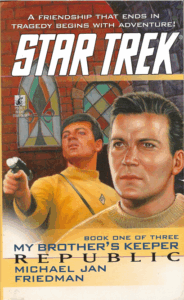
In today’s episode, Kirk is wracked with guilt when he has to put an old friend down. But when Spock decides that giving his captain an opportunity to yap about his feelings will help him understand humanity better, he ends up getting an earful about a former boyfriend. Where did James “R.” Kirk come from? Do aunts and uncles make better parents? And what makes someone a “walking freezer unit”? All this and more in Republic, the book that has no time for people who can’t make the jump.
Republic
Author: Michael Jan Friedman
Pages: 267
Published: January 1999
Timeline: The present day of the story takes place during and just after the episode “Where No Man Has Gone Before”, while the events of the past occur about 14–15 years before that.
Prequisites: “Where No Man Has Gone Before” makes for a good rewatch, though the end of it is recapped in the book.
Sometimes a TV show will have an episode with a guest that the audience is expected to buy as a longtime friend of one of the main characters. We don’t know anything about this person before the episode, and we’ll never hear about them again, but for the duration of the episode, we are expected to be as invested in that person as the characters apparently have been for however many years. Star Trek (re)started with just such an episode, “Where No Man Has Gone Before”, in which part of Captain Kirk’s struggle to put the burgeoning godlike powers of Gary Mitchell asunder derives from the fact that Mitchell has been his friend for 15 years. Republic is the first of three novels that seeks to color in the pages of the time before Gary Mitchell went mad with power by giving him some more human dimension.
A fair chunk of the book reenacts the last few scenes of the episode and goes on past the end a little bit. In that extra space, Spock suspects that his cold Vulcan nature may have kept him from doing enough to console his captain in his grief, and after talking to a yeoman about it, he decides to visit Kirk and listen to him talk about Gary Mitchell to his heart’s content. Kirk realizes he hasn’t done much to try to connect with Spock on a level beyond crewmates either, and takes him up on it. Just as well, I suppose; I don’t think Kirk would have talked to a ship’s counselor even if they had had them in his day. Spock may have been beaten at tridimensional chess earlier that episode, but he’s certainly winning at chess of the heart here.
When Gary Mitchell meets Jim Kirk at Starfleet Academy, the latter is far from the winsome maverick we know from the series. He’s teaching at the Academy at the tender age of 18, which would be enough by itself to earn a wedgie in the New York City public schools Mitchell came of age in. But he’s also uptight and a huge nerd, and has a reputation among his peers as a tattletale for reporting a friend (now former, natch) on a training cruise. He also has zero of his signature rizz, clamming up around the ladies and hiding behind the excuse of not wanting to be seen fraternizing with subordinates. Enter Gary, who is preternaturally good at reading people and their intentions, and uses that to assess Kirk and help him figure out how to develop that missing X-factor. Kirk, by the same token, insists Gary can’t just get by on intuition forever, and hopes to mold him into someone capable of working harder in addition to smarter.
Thanks to Kirk, Mitchell makes the cut for a training cruise on the USS Republic over some other more qualified cadets. He gets on Captain Bannock’s bad side when he hacks the navigation console to say hi to Kirk on the bridge, and Bannock explicitly promises to do all he can to “drive a wedge between” the two friends. Despite that, he assigns them together on a security detail for an important peace-brokering ceremony on Heir’at, where they are given orders not to leave their post in the local bakery under any circumstances. Will they be good little soldiers and stay put, or accept the charges when adventure calls collect?
Kirk/Spock is the foundational relationship of modern homoerotic fan fiction—but what Republic proposes is: what if Jim/Gary walked so Kirk/Spock could run?
The off-the-charts erotic energy between James Kirk and Gary Mitchell is the thing that looms over this whole book and the thing that has to be talked about here. Maybe it was intentional, maybe it wasn’t, but regardless, it’s here and it demands to be noticed. Jim and Gary have intense arguments over sweaty matches of racquetball. When two women show up to claim the arena after Jim and Gary’s time slot runs out, Gary spins it into a chance at a double date. Kirk declines, leaving Gary agog, but his excuse about fraternizing with subordinates never seems quite as convincing as the simple theory that he’s into men (or perhaps even asexual). A particularly heated conference after class also crackles with the same type and degree of eroticism. You know you can’t deny the frisson when you scream at the book, multiple times, out loud, “Just f××× already!”
Eventually, Jim does poke out of his shell long enough to have something shaped like a relationship with an Andorian crew member named Phelana Yudrin. But at a pivotal point in the security mission, she, Jim, and Gary have no choice but to jump from the roof if they want to pursue the people kidnapping the telepath that’s key to the peace ceremony between the Heir’tza and the Heir’och. Jim and Gary make the leap, but Phelana refuses, and it’s ultimately this that causes Kirk to break up with her at the end. In his words: “She wouldn’t make the jump.” And okay, sure, obviously one meaning of that is that he can’t stay with anyone who could hew so closely to the letter of the law when they see real wrongs being committed right in front of them, but anyone with eyes in their head can see there’s more layers here than a Super Bowl bean dip.1
Without that, there honestly isn’t much to the book. It’s a pretty standard “cadets go against orders and regulations, oh no we’re gonna get in trouble, no actually that’s what great officers do, here’s your commendation” narrative. But for the folks who like a little kink in their slink, a little sub in their text, this one is definitely an all-timer. I don’t know if the next two books are going to approach the critical homoerotic mass this one did, but if they do, we’re in for a ride.
MVP & LVP
- The MVP of the story is Gary Mitchell. Mitchell has far more of a formative impact on Kirk than vice versa. If he doesn’t get Kirk out of his stuffed-shirt mentality, then who does?
- The LVP is Gary’s roommate, Karl-Willem Brandhorst. He’s really only here as the kind of guy who gets gobsmacked when someone like Gary gets chosen for a training cruise and he doesn’t. What did he do wrong? Well, not be one of the main characters, for one. And also not have a
boyfriend who can get you onto the list. Other than those two extremely important qualities, nothing!
Stray Bits
- It’s really too bad about Phelana Yudrin. She’s very nice, and it was a kindness to throw the heteros a bone with a hot naked Andorian to think about. But Kirk’s right: she just can’t make the jump, and as we all know, that puts a pretty hard stop on your future prospects in Starfleet. Enjoy your “Lieutenant Picard in astrophysics” career, Phelana.
- I love Friedman’s solution to the “James R. Kirk” continuity goof. When invited by Gary to play racquetball, Kirk says, “Racquetball’s my middle name!” Not only does that recast it as one of those little moments you only realize cements the beginning of a long-lasting friendship in hindsight, but it also imparts a little humanity to Gary Mitchell’s climactic moments in “Where No Man Has Gone Before”, showing that even as the all-powerful god was taking over, there was enough humanity left in him to slip an inside joke through the madness, however morbid that may have seemed in that moment. (85)
- Friedman also semi-cleverly rehabilitates Mitchell’s nasty “walking freezer unit” comment, originally made about Elizabeth Dehner in the episode, by having Mitchell apply it here to Kirk. I don’t think it entirely gets out the misogyny stain, but it’s a nice attempt. (93)
- From pages 238–39:
Gritting his teeth, the lieutenant set out after him, forcing himself sideways between two burly onlookers.
“Where do you think you’re going?” one of them asked, his yellow eyes slitting with undisguised annoyance.
“Yes, where?” asked the other Heiren. “Didn’t your foster parents teach you any manners?”
Kirk understood the reference. Heir’tza traditionally gave their children to uncles and aunts to raise, believing that bloodparents were liable to coddle their offspring.
What a weird thing to throw in the middle of an action scene. A completely throwaway piece of worldbuilding that has no bearing on anything that happens in the story? I mean, interesting concept on paper, but what is it doing sitting out completely raw? So weird.
- “Of course, the captain had ‘cleaned up’ the story a little to accommodate the Vulcan’s sense of propriety, and left things out that were nobody’s business but his own.” OH YEAH. I’M SURE HE DID. (263)

- The only thing Friedman talks about with regard to this trilogy in Voyages of Imagination is how it’s like in Born on the Fourth of July where Tom Cruise has to tell his friend’s parents he accidentally shot and killed him. That’s all there is to talk about here, Mike?
First Assessment
Average. Were it not for the heavy queer subtext, there would be a lot of nothing here, but instead, that singlehandedly sustains the duration, to say nothing of making the Kirk/Spock thing make even more sense than it already did. Republic sees to it that it locks in the series’ reputation for homoerotic tension from season one, episode one. I don’t know that I would have considered this book very memorable otherwise, since its ostensible mission about protecting a telepath during an important peace ceremony is fairly boring, but I know when I look back on it in the future, there’s only one ship I’m going to remember sailing.
NEXT TIME: Jim and Gary’s friendship continues in Constitution
Mike Schroeder
This review, more than most, makes me interested to crack the book open and give it a spin. Here’s hoping the whole trilogy maintains this energy!
Adam Goss
Does the book explain how an 18 year old is TEACHING? (And does it say what exactly he is teaching?)
jess
Maybe there’s not a traditional K-12 school system in the 2240s/50s. Or he’s just really smart and finished it all online really fast. He’s teaching some sort of history class.
I suppose Friedman thought it kind of fit with his legendary aura to be able to be awesome at anything he feels like pursuing, but no matter how you slice it, teaching an Academy course at 18 is something you’d expect more from Spock, not him.
Daniel Huffman
Going to admit: the erotic subtext went right past me. But, that’s why I read reviews, to get insights I missed!