

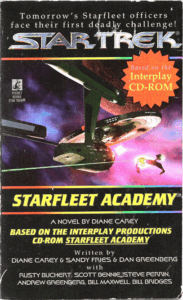
In today’s episode, a fresh-faced cadet contends with textbook crew dysfunction. But when the local debate bros break out the hooded robes, he finds himself taking political action as well. Are you missing out on cinematic gold by choosing the book over the game? How do you elude the telepath bouncer? And how does Kirk feel about someone else trying to cheat at the Kobayashi Maru? All this and more in Starfleet Academy, the book with the first-person straight shooter.
Star Trek: Starfleet Academy
Author: Diane Carey
Pages: 223
Published: June 1997
Timeline: About two years before Star Trek VI: The Undiscovered Country
Prerequisites: None are strictly necessary, outside of maybe a passing familiarity with movie-era TOS, although some of the more top-of-the-class performances in the game imply that the success of the Meclanti mission is what convinces Chancellor Gorkon of the outmodedness of the Neutral Zone as a concept and the value in opening peace talks with the Federation.
Of all the Star Trek novels I would have guessed to be distressingly timely, a novelization of a FMV flight-sim game would not have been among them.
Starfleet Academy was released for PC and Mac in 1997, sold decently enough, and enjoyed the honor of getting at least one expansion pack, but didn’t really have the legs of more memorable contemporaries like Star Wars: TIE Fighter, and the acting isn’t quite as inspired, despite soul-warming appearances from William Shatner, George Takei, and Walter Koenig. Unlike with Star Trek: Klingon, I elected not to watch most of the game after a few missions, since there was about four times as much footage to sift through and it wasn’t quite thrilling me as much. Reading the novel is probably a better idea in general anyway, since you don’t have to worry about all the dogfighting and can just read a story that trundles along at a pretty nice clip.
That story follows David Forester, a cadet on the command track who quickly becomes best known for punching none other than James T. Kirk himself during a simulated terrorist attack at convocation. Despite the blunder, he’s the only one to take decisive action and not freeze up during the “attack”, so he gets command of a group of cadets: Geoff Corin, a glib and lazy wiseacre who comes from wealth and isn’t taking his scores and talents as seriously as he could; Sturek, a Vulcan; Jana Akton, a Trill whose lack of need to be worried about causes her to sort of disappear into irrelevance; Vanda M’giia, the sole Andorian survivor of a Klingon massacre; and Robin Brady, a terminally shy engineering student who feels his best friend being ripped from him by the command track.
The book concentrates primarily on the growing threat of a splinter group called the Vanguard (no relation), with a secondary focus on mending the dysfunctionality between Forester’s cadet group. The Vanguard, most vocally supported by a senior cadet named Frank Malan, posits that peace is for weenies and thinks races that don’t live by Federation ideals should be dealt with using weapons rather than mouths. Ostensibly, he means Klingons and Romulans, though he tips his hand early on and makes it clear it’s a human supremacy group. Despite not being human, M’giia in particular is drawn to their inflamed rhetoric, especially after another attack destroys Bicea, the world near the Klingon Neutral Zone she and her remaining relatives adopted as their home after the Lursen Prime massacre, leaving her the last of her line.
But lest you get too mired in the unsettling parallels to our cultural moment, the book also indulges in the opportunity to get a peek at Kirk, Sulu, and Chekov in full mentor mode. They’re firm but fair with the cadets, and do a good job of emphasizing the seriousness of their training without unnecessarily scaring them. In particular, there’s a lot of fun to be found in a scene where the three legends hop on a simulation with David and Sturek for a minute and Chekov, posted at the engineering station, layers Scotty’s brogue over his own Russian accent in a way that breaks the brain to imagine. But it’s not surprising, considering [gestures vaguely at Diane Carey], that some of that fun comes at the expense of some important details that might have been nice to know without watching a longplay.
For example, she doesn’t explore any further about the ship that attacks Bicea once it’s revealed that it uses neural network technology. Since the Klingons not possessing that tech is enough to clear them, all further developments in that arc are omitted. You have to play the game to even learn that the thing has a name (the Meclanti), much less that it’s just a sentient lifeform looking for energy to ensure its survival and has a convoluted logic system where it only understands its own existence and destroys anything (stars, planets, other ships) it considers “random”. Additionally, some classic missions are replicated in the game, such as “Balance of Terror”, but only the Kobayashi Maru survives to the book—justifiably so, given that this is an Academy story. Like Kirk, Forester decides to reprogram it, but then gets an extra surprise that forces him to do more than just copy the greats.
But the part that stands out most to me is the Vanguard plot. The right-wing rhetoric spewed by Frank Malan and the news outlets playing in the lounge might have felt and sounded over the top in 1997, but it will immediately ring true to a reader in 2025. Malan may be a meathead, but we’re now all too aware of how much damage even those perceived as unserious or dumb can do when they get a little taste of true power. Even so, I admit I underestimated the Vanguard as a serious threat right up until Forester infiltrated a meeting with M’Giia and Malan laid out their true plans. There’s also a sad truth to M’Giia’s attraction to the group despite their open loathing of nonhuman races.1 I guess even in the 23rd century, there are those who believe the sehlat will never eat their face.
There’s always more than a little trepidation when dipping into Diane Carey Trek, but you can be reasonably sure that when she’s working in the TOS milieu, she’ll be on both her most capable footing and best behavior. It always takes me a long time to swallow the bitter pill when knowing one of her books is next, but once I committed, I was surprised how smooth it went down. She does a good job not letting the big stars take over too much, and has a good sense for what in the game was worthy of making it into the text. There’s much more to the game than what she’s able to translate to the page, but it nevertheless stands as a solid portrayal—maybe even a preferable one.
MVP & LVP
- The MVP for this one is Sturek. He’s said to be a genius even among Vulcans, and his research is critical in clearing the Klingons of the Bicea incident. He nearly pays for it with his life, but he’s a solid reminder that behind every legendary captain is a Vulcan science officer.
- My choice for LVP is Jana Akton. As I mentioned above, she’s already pretty competent, so without the need to constantly be checked on by Forester, she just sort of disappears into the background, and is neither as strong a contributor nor as dynamic a presence as characters like Sturek and M’Giia (though she is a considerably better actor than either of them).
Stray Bits
- The Starfleet Academy novelization is told from a first-person perspective—a rarity in Star Trek literature, but most notably employed by Carey herself, all the way back in her first stories for the franchise.
- Some other arcs that get elided include a series of encounters with a being of immense psychic strength named Alshoff and some standoffs with a maverick pilot named Margaret Horn, the rebellious daughter of the leader of a colony whose sun is among the celestial bodies being consumed by the Meclanti. It’s possible these were cut for being purely simulated and therefore arguably not as interesting or valuable as real-life experience, though one can’t help noticing Maggie Horn is an extremely capable, independent woman, which would go a long way toward explaining why Carey wouldn’t have been interested in her.
- The Vanguard has a telepath who can determine how devoted a person attending a meeting is to the cause and kick them out if they’re found wanting. Considering how frightening a concept like that is, it’s a wonder they don’t do worse when they root out a nonbeliever.
- Frank Malan, p. 54: “There’s got to be more to command than regulations, or an android could go out and do it.” I don’t know, I always thought that worked out pretty well.
Final Assessment
Good. Diane Carey’s novelization narrows the video game’s somewhat scattershot focus and concentrates on the arcs that play best to a Starfleet Academy story’s strengths, like fledgling crew relationships and burgeoning political movements. In the process, she turns out a quick, fun read that offers a nice rundown of the quintessential command track experience. Best of all, it’s not plagued by the dollar-store quality of 1990s CD-ROM acting, and if you were around at the time, you know that’s a pro you can’t put a price on.
NEXT TIME: Side Trekked #4
Steve Mollmann
I only played part of the game (I am very bad at videogames), but I remember liking this one a lot; it very much plays to Carey’s strengths as a writer. It’s a lot like the two Piper books in good ways.