

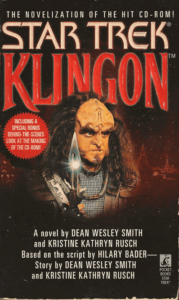
In today’s episode, Chancellor Gowron leads a conference to figure out how to give the galaxy a crash course in Klingons. But when the official talks start to melt like an unattended jumja stick, his stories at the lunch table might provide another path to victory. Can you even get a salad from a star system with no planets? How good an ace up your sleeve is the video game for Six Degrees of Kevin Bacon? And what one thing will secure its place in blessed Trek memory? All this and more in Star Trek: Klingon, the book that can get you two of some things.
Star Trek: Klingon
Authors: Dean Wesley Smith, Kristine Kathryn Rusch
Pages: 217
Published: May 1996
Timeline: Before “The Adversary” (DS9 3×26), since Sisko’s rank is commander, but, more surprisingly, also before the game itself?! I promise it makes sense.
Prerequisites: None (great introduction to Gowron if you don’t know him, too)
Borrowable from Archive.org? Not even on there in an unborrowable capacity.
In the liminal space between the 16-bit era of video games and the advent of 3D in same resides the fad known as full-motion video (FMV). Video games have long had an inferiority complex toward movies, both self-inflicted and externally exerted, and FMV was one of the earliest means by which developers sought to bridge that gap. With a few blockbuster exceptions, it didn’t pan out—it was too expensive with too little payoff, and most of the games made for the medium suffered from clunky interfaces, cheesy acting, and byzantine solutions to their puzzles.
The enduring lesson of the FMV craze was to not try to be something you’re not. Video games are video games, not movies, and they have their own qualities that make them a unique form of artistic expression. Later on, certain developers would learn how to make video games more cinematic by leaning into the innate strengths of the medium rather than chasing a short-lived hype train. But at the time, they seemed like the next big leap in adventure gaming, and so it’s only right that Star Trek entered the fray and tried to make good on its reputation for blazing the trail to the future by giving it the old college try.
Star Trek could be argued to be a little better suited to FMV than most properties, not only because it already had a strong televisual pedigree at that point, but also because the concept of the holodeck gives games set in that universe a perfect foundation for immersive interactive adventures. Sure enough, Star Trek: Klingon, published in 1996 by Simon & Schuster Interactive, is indeed framed as a holodeck simulation. Gowron (Robert O’Reilly), the High Chancellor of the Klingon Empire, guides you through the true story of Pok, a fledgling warrior whose father Torghn dies after throwing himself in front of a rogue sonic screwdriver Romulan assassination probe programmed for Gowron. As Gowron takes Pok to the stars to “close the circle of vengeance”, the player gains insight into various aspects of Klingon culture, like what actions would be perceived as a challenge, when they believe weapons are necessary, and how to honor your elders.
I don’t know how easy or frustrating Klingon was to play, but watching a longplay before reading the book was a lot of fun, and in fact, I’m very glad I did that, because the game and the book are beasts of very divergent natures. If you’ve got an hour and some change to spare, you should see the game in action too.
Dean Wesley Smith and Kristine Kathryn Rusch are credited with “additional writing” in the game’s credits, and if that’s referring to the novelization of the game, then boy howdy is that an understatement. Except for , the game and the book couldn’t be more different. Whereas the game represents the finished holodeck simulation, the book takes place before it was made in the meetings that culminated with the simulation’s creation. Luminaries such as Gowron, Captain Jean-Luc Picard, and Admiral Edward Jellico meet at Deep Space Nine to find a way to help Federation citizens develop a less stereotype-informed understanding of the Klingons, and though the official talks don’t go so well, at meal breaks, Gowron tells Pok’s story to a mostly Starfleet audience, with Lieutenant Barclay in the player’s shoes stammering through choices.
On top of all of this rests a fascinating meta-layer that’s too delectable to not spoil at least a little bit. As in the game, an early attempt is made on Gowron’s life in the novel, which is eventually revealed as being carried out by the son of someone murdered in the game on behalf of the Duras Sisters. It’s two birds with one stone; this guy gets to satisfy his desire for revenge, and Lursa and B’Etor rise to power with Gowron out of the picture. So Gowron is trying to avoid being murdered while telling a story in which he tries to avoid being murdered. It ain’t easy being high chancellor.
Both the book and the game surprised me in pleasant ways. I expected the book to offer a fairly rote retelling of the game’s winning inputs with some details fleshed out around the margins to hit the standard 270, ultimately serving as a magnanimous concession to those who didn’t want to buy an expensive computer game to access brand-new TNG material. But Smith & Rusch went way above and beyond, preserving the telling of events in a way that’s true to the game while situating them in an entirely new adventure that makes engaging with it both ways a worthwhile experience.
Meanwhile, the longplay of the game kept me engaged not only with its brisk pace, better-than-average acting (for FMV games), and consistently buoyant humor, but also with a cast of character-actor ringers, including J.G. Hertzler as an older Klingon named Ler’at, whom Pok challenges and later befriends and bestows honor upon. But there’s also legendary That Guy Mike Hagerty as weapons-dealing bartender Meska and Joel McKinnon Miller as a Pakled, which was no doubt the tipping factor in him scoring the role of Scully on Brooklyn Nine-Nine. The latter in particular cracks off some banger lines in a performance that kind of makes you wish Pakleds appeared at least a little more often.1
It takes some pretty significant padding to make this look like a normal-sized book. About 75 pages at the end consist of a peek behind the scenes at the game’s production (written by David Mack before he had even a single Trek novel to his name) and previews of all four Invasion! novels. And not everything in the framing story worked for me, most notably Riker’s attempts to have an uninterrupted dinner with Dax, where the implication is that he hopes to do a little joining of his own. Still, it’s a brisk read that goes down smooth, and just what the doctor ordered after four books of the Dominion Bore. And if you’re not familiar with Robert O’Reilly’s performances as Gowron, this is a great place to get introduced to him, whether through the game or the book.
MVP & LVP
- I think this might be my favorite Gowron appearance ever. He does a great job of making the player feel included in the immersive holodeck sim and capably entertains a captive audience in the book. In particular, I really liked how he appreciated Pok’s poetic talents after giving Ler’at the GaTH’k (ode of respect). If the idea was to demonstrate to an unfamiliar audience how layered the Klingon definition of honor is and how they celebrate and value friendship as deeply as any other culture, I think he succeeded spectacularly at that.
- I understand and sympathize with the case for considering him the man for the job in “Chain of Command”, but sadly, Jellico doesn’t do much to acquit himself here. You can tell it’s basically just him holding up the talks and no one else, and when he gets knocked out cold in the hostage situation and needs to get carried around by one of Gowron’s guards, he becomes a literal load as well as a metaphorical one. Stay behind the desk, Ed.
Stray Bits
- If Star Trek: Klingon endures in the canon for one reason, it will be as the source of the most famous Gowron gif on the internet (seen below). And in case you want to argue that claim: it’s the first thing that popped up when I searched “gowron gif”. Also, like many such things, it’s even funnier when you’re familiar with the full context.

- The book contains a few references to the Black Fleet, one of which is even in the game itself. As a fan of The Final Reflection, seeing that referenced always makes my heart happy.
- Hilary Bader, who wrote this game, was an Emmy-winning freelance writer who provided the story for several TNG and DS9 episodes, and even wrote the best Lwaxana episode (“Dark Page”). She died in 2002 of breast cancer at age 50. I have no doubt she fought an honorable battle against it.
- The Pakled trader saying “I can get you two of some things” while being beamed away got a huge laugh from me. Sadly, the line only appears in the game, not the book.
- Dax eats a Tautean salad in Quark’s bar, which isn’t so much a callback as it is a lateral toss; Smith & Rusch’s TOS novel The Rings of Tautee was published the same month as this novelization. (35)
- When taking over the Bird of Prey on which he and Jellico are held hostage, Gowron gives a dressing-down to a Klingon captain named cha’DIch, a name that clangs a little bit on the mind’s ear if you recognize it more as a title. (154)
- “Riker decided right at that moment that he would even offer to help on the production of such a program if it happened.” — A cute joke, seeing as Jonathan Frakes directed the game. (170)
- One name dropped in the “Making of” section made me sit up straight when I saw it: Liz Braswell, who is probably now known better for her contributions to the series of Twisted Tales novels that are basically what-ifs for Disney characters, usually villains. I stock some of those in my classroom library, including a few by her. Sure enough, before she was a novelist, she produced video games at Simon & Schuster Interactive. Man, the range of names involved in this game is wild.
- Speaking of Braswell, she makes an odd remark at one point in the Making Of feature: “And in Klingon society if you don’t like your boss you challenge him to a duel. If you kill him, you get to take his job, which is the American dream.” In the immortal words of Tim Robinson: “You sure about that?” Don’t speak for me, lady—that ain’t no dream I ever had. The boss can have [gestures vaguely] all of that. (216)
Final Assessment
Good. Sometimes they play the role of hired hands a little too mechanically, but Smith & Rusch put a lot of love into this one and it shows. Instead of just providing a standard run of the game in text form with the requisite bonus scenes to justify a novelization, they wrote a whole new framing story that put the creation of the game’s holodeck simulation into a broader context while pulling off a nifty meta trick and incorporating several more fan-favorite characters, including some not seen so often. More than just a companion to the CD-ROM game, it’s a fully fleshed-out adventure all its own. Both are well worth your consideration, however. FMV games may not have stood the test of time, but the bones of this one, and the book that goes along with it, certainly do.
NEXT TIME: Learning alongside legends at Starfleet Academy
Adam
Ok I have to know, what does the Kevin Bacon game have to do with this game and book?
Matt N.
I had no idea there was an accompanying book for this game! I played it back when it released and enjoyed it, and still own it. As an unapologetic fan of FMV gaming, I really should give this another play. And I’d love to read the book now.
Star Trek: Borg is also good fun.