

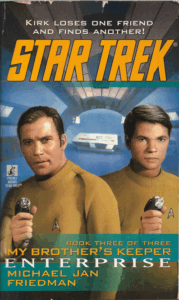
In today’s episode, Kirk finally gets let in on a secret he’s been shut out of for over a decade. But when actual ridge-headed Klingons get loose on his Enterprise, he has to figure out how to clean up a TNG-level spill with a TOS mop. How much of this trilogy is actually brotherly keeping by volume? Will book Klingons ever fully escape Ford’s shadow? And was there ever a more satisfying team to root against than the late-90s Yankees? All this and more in Enterprise, the book that features scenes from an Italian restaurant.
Enterprise
Author: Michael Jan Friedman
Pages: 270
Published: January 1999
Prerequisites: Republic and Constitution, the first two books in the My Brother’s Keeper trilogy
Timeline: Seven years after Constitution, fourteen years after Republic
Not to be confused with: Enterprise: The First Adventure by Vonda McIntyre or Star Trek: Enterprise
As I might have suspected, the power of Jim Kirk and Gary Mitchell’s friendship isn’t enough to support three books—not back-to-back like these, anyway. Gary doesn’t even figure into this one all that much. Enterprise is more of a passing of the “trusted confidant” torch from Gary to Spock. Jim and Gary interact very little in this book, and in fact are separated for most of it. As far as their friendship is concerned, you only get anything meaningful about that out of the first book, and just look at the absolute shock on my face when we get to the end of this thoroughly exhausting trilogy and it turns out Republic is the only good one of the bunch.
Before you can get to any of that, however, you have to wade, for a third time, through a ton of setup before the real action starts—and this time, it’s over half the book! Way too much of the runtime here is dedicated to exposition, including retelling the events of “Where No Man Has Gone Before” again! I know this is at least a little bit pre-“easy access to episodes” (outside of syndication), but I think we get it. Fourteen years may have passed between the events of Republic and Enterprise, but Friedman writes as if there was a fourteen-year gap between the actual publication of the books themselves.
One thing Kirk struggles with in this endless setup phase, and what could have been a more interesting thematic direction for the story, is how any earthbound person can possibly wrap their mind around the sorts of decisions a starship captain has to make in space. Even in a time when faster-than-light travel and beings from other planets are a fact of life, you can’t really understand if you aren’t the one out there calling the shots in the heat of the moment. Gary’s mom goes off on Kirk when he finally is able to tell them the truth about what happened, and even though she comes around pretty quickly, I think there’s more truth in that initial reaction. It would have been harder for Kirk to accept that he did the best he could by telling Gary’s parents the truth and leave it up to them to figure out how to process it, but ultimately more rewarding.
Enterprise does at least finally take the lid off the weird coverups the first two book set up. In Republic, all cadets on the titular ship are confined to quarters at one point and not told why, and when Jim and Gary go snooping in the sensor logs for answers, they find them completely deleted and get reprimanded for their trouble. Then, in Constitution, they roll up on a planet they were ordered to go to only to find a Klingon battle cruiser and get told to turn around by Ellen Mangione, once the first officer on the Republic, now an admiral (and, as far as I know, no relation to the dearly departed Chuck).
After fourteen years, Admiral Mangione finally lets Kirk in on the real scoop: that planet he and Gary were never allowed to know anything about is basically being used to imprison some genetically enhanced rogue Klingons who call themselves the M’tachtar. The brief Kang cameo in the second book also comes to fruition here, with the imposing Klingon now a captain with whom Kirk has to work to outwit and subdue the menace that’s managed to escape the confines of the sere desert planet they’ve been forcibly kept on all these years. Any moment involving Kang was fun (I always love imagining Michael Ansara’s droning baritone and projecting it onto new lines), and in this book, you need to take the bright spots where you can get them.
There is so much in this book that never pays off. In the initial part of the main story, Spock gets upset (or as perturbed as Vulcans get, at least) that Kirk often takes Mitchell’s suggestions over his first officer’s. Maybe that would have mattered if they ever went to check out the once-in-a-lifetime wormhole situation they were originally assigned to, but they don’t, and no such anxiety ever comes up again. There’s also no room to explore the implication behind the idea that, by every description given, the “genetically enhanced” Klingons are basically just TNG-era Klingons. That would become quite a problem if they ever wanted to join the Federation! Oh well, it’ll probably never come up.
With a title like My Brother’s Keeper, I kind of hoped there’d be more, you know, brotherly keeping in this trilogy, but only the first book really pays off in that regard. They maybe could have gotten away with making it a duology and skipping Constitution entirely, so that it didn’t sag so badly in the middle, as trilogies so often tend to do. But even then, that first book said pretty much everything that there was to say, and in an unexpectedly electric fashion, to boot. I have long been wary of reaching the point where they stretch stories that only need to be told in one book across two or three, and this trio, which has for the most part been a Herculean labor to want to read and to write about, has only validated my decision to approach with suspicion.
MVP & LVP
- My pick for MVP in this book is Spock. He gets some solid zingers off on Kang, which riles Kang up, but also shows him that anger is a glowing red weak spot for Klingons—doubly so for roided-out genetic freaks like the M’tachtar. A rare glimmer of joy in a mostly dire book.
- The LVP goes to Admiral Mangione. A cool enough character in the first book, but became very severe and closed-off in the second, and then got her lights knocked out in the third and had to be bailed out by Kirk and his crew. Probably one of the people Kirk was thinking of when he never wanted to be an admiral.
Stray Bits
- This book is dedicated to the New York Yankees, who were right in the thick of dynasty mode at this time, and who I will always associate with one of the most unctuous, unsavory people I’ve ever had the displeasure of knowing. So, barf.
- The waiter at Velluto’s, the Italian restaurant Kirk and Bones stop at, serves them Chateau Picard. Incidentally, the owner of Velluto’s is a really nice guy, and might have been my MVP if Spock hadn’t stepped up. (39)
- Lately I’ve been mixing reading the paperbacks with ebook versions to give myself more opportunities to read in situations where one or the other isn’t as convenient, in hopes of getting through the books faster (though with the amount of grading on my plate, you can see how well that’s going). Anyway, there are often myriad transcription errors in the EPUBs, one of which especially caught my eye. In this case, Rayburn, a redshirt,1 somehow gets rendered as “Ray-bum” at one point. I understand the kerning issue, but the out-of-nowhere hyphenation? Someone was really trying to make sure this poor rando caught a stray. (141)
- The genetic altering of Klingons did what is often a bad idea for a given Star Trek novel to do, which is remind me of a better one—in this case, The Final Reflection. Friedman must have been aware of this, since he refers to the main villain as the chancellor’s “ruustai-cousin”, a probable nod to the “epetai” title that Ford established in that classic novel. As much as I love that novel, y’all, you can stop trying to make the Ford interpretation happen now. How far back is that one in the rear-view at this point anyway? [checks the archive] FIFTEEN YEARS? Good night!
Final Assessments
- Republic: Good
- Constitution: Bad
- Enterprise: Bad
Only the first book in this trilogy is worth checking out. It’s the only one that in any way lives up to the nominal purpose of helping the reader understand why Kirk might have struggled so much to put a close friend asunder. The second book starts drifting away from their closeness—out of necessity, granted, since the widening rank gap between Kirk and Mitchell prevents excessive fraternization, but still—and the third book makes it all but impossible. Combined with a bunch of plot elements that resolve either limply or not at all, this trilogy is a mess-and-a-half. Read the first one for the off-the-charts homoerotic energy alone; the second and third are safely ignored, however.
NEXT TIME: Quark and Rom contend with The 34th Rule (no, not that one…)
1 Pingback