In today’s episode, Kirk is wracked with guilt when he has to put an old friend down. But when Spock decides that giving his captain an opportunity to yap about his feelings will help him understand humanity better, he ends up getting an earful about a former boyfriend. Where did James “R.” Kirk come from? Do aunts and uncles make better parents? And what makes someone a “walking freezer unit”? All this and more in Republic, the book that has no time for people who can’t make the jump.
Occasionally, on Deep Space Spines and in meatspace, I have been accused of expressing certain ideas in a way that makes it clear that I have no interest whatsoever in discussion or debate. The specific word that gets used in most such cases tends to be strident. I’ve dialed the attitude back some as the years have passed, but I still let it poke unassumingly out of its burrow from time to time. Except for today, when I’m grabbing it with both hands, dragging it fully out, and holding it aloft like Rafiki in The Lion King to say this:
Women are, without question, the superior sex. This is a conclusion I feel cannot be escaped or avoided by anyone who wants to be thought of as a right-thinking person. I have spent forty years trying my best to be as aware of and present in the world around me as I can, and everything the evidence of my senses tells me is that women handle things more effectively. Which things? All things. In fact, thanks to millennia of being gaslit into believing that they are the more mentally and emotionally volatile sex, I say it’s eminently arguable that women have actually developed more strength and fortitude than they would have under more equal circumstances. Good work, men!
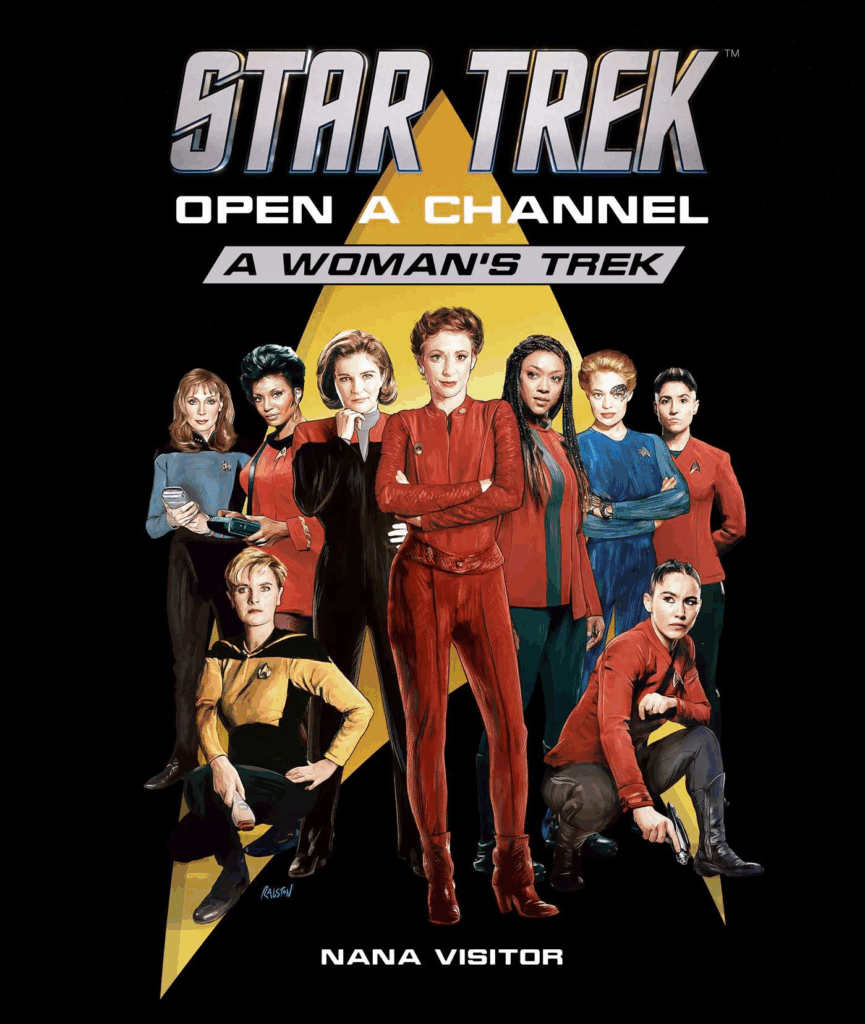
This opinion of mine got regularly reasserted while reading Open a Channel, a survey of the women of Star Trek written by a woman of Star Trek, Nana Visitor, who played Major Kira Nerys, the Bajoran freedom fighter turned liaison between her homeworld and the Federation, on Deep Space Nine. Star Trek has many more glowing red weak points than its reputation for progressivism suggests, and one of them is that it took this long to get a work that gives so many of such an important franchise’s women their due, but at least it’s here. Visitor spent years interviewing a number of female cast members and fans, ultimately producing a volume that provides an excellent, even-handed overview of what Star Trek got right, where it performed less admirably, and which of its female icons it properly edified and supported as well as those it did a disservice to.
This assessment even extends to the self; part of the throughline of the book consists of Visitor trying to distance her thinking from the expectations she felt she had to conform to in order to succeed in the Hollywood game. She does a great job keeping herself honest, always admitting when she’s the fossil from another era compared to the person she’s talking to. It also appears that talking to so many other bold women gave her the courage to speak openly about some of her own hurdles; some of the most brutal stories in the book are about things that happened to her. The book starts with an anecdote where her agent tells her she isn’t “fuckable”, and midway through she opens up about being kidnapped and raped during her time on Deep Space Nine and, going against the conventional wisdom of the time, testifying against her attackers in court. Both accounts are jaw-dropping, both for the bravery it takes to talk candidly about them and for the strength of her writing about them.
It’s interesting how the book progresses in terms of the openness of the interviewees. Early on, Visitor manages to gather several women who guest-starred on TOS under one roof to talk about their experiences. To this day, they groom and comport themselves strictly in line with the expectations of the era in which they worked, and when Visitor tries to broach more sensitive topics, they clam up. Contrast that with many of the younger actors on more recent shows, such as Tawny Newsome and Jess Bush, who claim they never experienced any of that and had the room to be who they were and never settle for anything less than their most authentic selves. It’s fascinating how the course charted by the women of Trek often looks a lot like the trajectory of progress for women in general.
When she can’t get an interview for whatever reason, as in the cases of Marina Sirtis (declined to participate), Jennifer Lien (in no condition to participate), or Celia Rose Gooding (busy filming), Visitor treads lightly and tastefully. She never fills in any blanks with assumptions, but does her best to provide a bridge with extant information. This is a book that is all about allowing women to control their own narratives, and when that’s not possible, Visitor wisely doesn’t force the square peg into the round hole. A given woman’s story is hers to tell—not even another woman’s.
I’m given to understand the physical edition of Open a Channel is more akin to a coffee table book, a sense I didn’t get from the Bookshop.org ebook I read. I’m kind of glad I didn’t read it that way, because I can imagine there might be a strong temptation to only read about the women of your favorite series and ignore the rest. There is something inexorable and implacable about the one-page-at-a-time nature of ebooks, however, that discourages one from jumping around so much, and so not only did it feel more informative and pleasant to follow the timeline from the beginning to the present, but also, the book is compulsively readable in that way that makes you go “Okay, one more chapter, I suppose OH YES HERE WE GO.”1It also helps that I got an iPad Pro for an early birthday present and I absolutely love reading on it, enough so that I might be able to ramp the production on Deep Space Spines, if not back up to once a week, then at least up to more than one review a month. Cross your fingers!
Although there’s a queen’s ransom of riveting and valuable stories here, it’s all too tempting to think about who didn’t make it into the narrative. Notwithstanding what I imagine to be the difficulty of getting in touch with someone as big as Whoopi (though I hope Visitor at least tried), the most glaring exclusion to me is Michelle Forbes (Ro Laren), though it’s at least kind of understandable why she’s not accounted for here—not only because she seems reticent to make Star Trek a significant part of her personal identity, but also because Visitor owes her own star’s ascent in large part to Forbes wanting to be in movies2Though I’d guess the demographic of a site such as this one likely remembers this with decent enough clarity, I think it’s worth noting that being in movies was once widely considered the ultimate goal of acting. There was little or no conception of anything like a life spent on the convention circuit. You could conceivably make something now out of Star Trek being your end goal, but there was no road map for what that looked like in the 20th century, because in that time there was a prevalent notion that if you operated primarily in the medium of television, you had “failed” to some nebulous extent that no one could ever properly articulate (because, of course, it wasn’t true). and declining to commit to a series, and it might have been awkward to have that electricity crackling between them. Diana Muldaur would also have represented a unique opportunity, having been both a guest star on TOS and a regular on TNG, and not especially well-received on the latter, for reasons beyond her control.
And though the presence of Lucille Ball, Dorothy Fontana, and Lucie Salhany suggest a willingness to acknowledge off-camera talent as well, there are a few women behind the scenes it would have been nice to see highlighted. Bjo Trimble is basically the reason there’s a third season of the original series, and given that there’s a small section of interviews with fans both famous and not tacked onto the end, it would only have been right and proper to make a pilgrimage to speak to the ur-fan. And the purview of this website may make me a tad biased, but there’s virtually no arguing that it was almost entirely women that were responsible for holding up the literary arm of the franchise in its early Wild West days. Some of the greats, like Vonda McIntyre and Ann Crispin, left us long before this book was a glimmer in Nana Visitor’s eye, but a conversation with, say, Diane Duane or Paula Block might have been a nice reminder that there’s more to the franchise than TV.
These are microscopic quibbles, however, and ones expressed by a man, at that. Q willing, someday there’ll be an Open a Channel 2 that gets in touch with the women whose work continues past the time frame covered by this first installment, even if that work isn’t continued by Visitor herself. But for now, this is more than hearty enough a serving. Open a Channel is absolutely essential reading not just for fans of Star Trek, but for those interested in the stories of women period. Perhaps there will come a day when even the progress charted in this book seems primitive compared to the heights achieved by then. It often doesn’t look that way, especially from our benighted present, but that’s what Star Trek is all about: hope. That’s something this book has given me more of than just about anything else in a hot minute.
Stray Bits
Cover Art Corner: The cover art looks like one of those 80s movie posters where some of the actors look exactly right and some of them—except in this case, they all look exactly right. Good job, Tom Ralston!3I feel it must be noted: not a woman.
One bit of Visitor’s verbiage I appreciate is her insistence on dropping the “disorder” from PTSD, instead opting to call it simply “post-traumatic stress”. As she astutely points out, it’s hardly a disorder to be stressed out by something that was traumatic.
There is an especially astute observation in here about how the women who get to play aliens on TV and in movies are rather fortunate, since it allows them to act out personalities and express beliefs and opinions that are not typically afforded to human female characters. This is an advantage of sci-fi in general, and one I try to impart to my students when we include it in our exploration of genre via a variety of short stories, where we can explore aspects of ourselves that are difficult to talk about human-to-human more easily when they’re projected onto a non-human character who isn’t expected to know or share our customs, but I had never considered what opportunities it opens up for the woman who gets to portray one on screen.
From what I know about the guy, it feels like Open a Channel goes pretty easy on Rick Berman. Even though Berman has nothing to do with Star Trek anymore, Visitor’s comparatively soft handling of a guy that got a huge swath of the franchise tossed in horny jail seems like one of the ways she remains “stuck” in the “cultural amber” she regularly refers to, despite her best efforts. And if her specific experience with him was positive overall, I’m not going to take that from her, though considering how he was by all accounts pretty awful to her contemporaries, even if not to her specifically, one might at least think there’s something to be said for your friend being nice to you but rude to the waiter, so to speak.
I walked away from the book with a significantly higher estimation of Voyager in particular. I don’t dislike it by any means, but my main feeling about it tends to be that it is charmingly silly more than anything else. However, it’s possible to believe that while not letting that belief get in the way of what powerhouses for feminine empowerment Kate Mulgrew, Roxann Dawson, and Jeri Ryan (as Kathryn Janeway, B’Elanna Torres, and Seven of Nine, respectively) were. I’ll try not to make that mistake anymore.
NEXT TIME: Kirk tells all about Gary Mitchell in Republic