

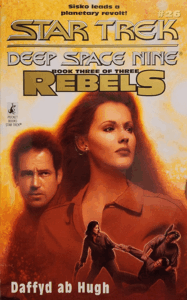
In today’s episode, Sisko’s done all the training he can do, and Kai Winn’s done all the talking she plans to do. With permanent brain damage and another occupation in the cards, it’s time for both to make their last stand against their respective oppressors. Is being an asshole a right that can be earned? Has the admiral from hell actually been to hell? And can a throwaway line skunk an entire premise? All this and more in The Liberated, the book that just might like video games a little bit, maybe.
The Liberated
Author: Dafydd ab Hugh
Pages: 238
Published: March 1999
Timeline: See previous
Prerequisites: The Conquered and The Courageous
In our third and final Rebels jaunt, we start out checking in on the Tiffnakis, who have yet another stupid new name that I flatly refuse to acknowledge. Unburdened by their tech toys, they’re writing airtight constitutions, maximizing the efficiency of their military workouts, and inventing new things at a breakneck clip. They are basically John Travolta in Phenomenon (a movie that, incidentally, turned 30 not too long ago), exhibiting new talents at an exponential rate. And all Sisko and his bunch had to do was take away the tech teat they were suckling at! Surely there’s not a metaphor here. (Not one that’s explored, in any event.)
Speaking of 30 years ago, Ragat is still consumed with his downfall from that time, blaming Kai Winn, though he never mentions her by name, and Julian and Jadzia don’t know who he’s talking about when he mentions a “sister”. Meanwhile, back at home, the Liberated have assumed full control of the station and easily subdued the predictably hot-headed Kira. Kai Winn, however, remains cool as a cucumber; what could she have up her sleeve?
Another more urgent threat here is the cyanogens, chemical agents in the water, air, and organic life of Sierra Bravo 112-II that prevent the senior crew from eating the food or breathing the air long-term. It’s been kind of lightly thrumming in the background the whole time that they’re harmful, but this book is where that reaches critical mass, with actual wasting and decreased mental acuity setting in. So not only are they having to help the Tiffnakis through their analog growing pains, there’s also sort of a de facto timer on their efforts.
I liked The Liberated more than the previous two books primarily for a couple of reasons. One, it’s less jumpy between plot arcs. You get to spend more time with each group, even sometimes remaining with them at the beginning of a new chapter, and the change in pacing does a lot to improve several of the ongoing threads. Second, the reveal about the nature of the Liberated ended up being worthwhile. Kira realizes they act the way they do because they were former prison guards for the Dominion. She works out that they are/were one of the Dominion’s highly specialized slave races, like how the Jem’Hadar provide the muscle and the Vorta make for more easily approached (if gratingly obsequious) middlemen.
I actually kind of love this reveal. It demonstrates a solid understanding of how thoroughly the Dominion subjugates and rewires entire populations, and also underscores how unsettling and vile that entire process is. The races that the Dominion enslave come out the other end of that trauma able to approach situations and solve problems from only one very specific band or category of experiences. In that light, it makes sense that a party attacked by them would stop trying to negotiate with them fairly quickly. Reason is unlikely to work on someone operating on that narrow a bandwidth; you can’t just tell someone like that that you can’t go out and oppress a populace right after you just got done being oppressed yourself. And it’s a double bad idea if that populace is Bajor, who also recently got out from under a cruel dictatorship and is not exactly champing at the bit to re-up for round two at this time, thank you very much.
What I don’t love quite as much is that it took three books to get to this point. This is very clearly a story that seeks to center Kai Winn’s past and show how that informs her thought process in the present, but whether it was the author’s idea or an editor’s, it’s all just sort of clogged up with a bunch of side stuff. If they could have contrived a way to get most of the main characters off the station (excepting Kira), made absolutely no mention of them until they got back, and reduced this from three books to one, I think I’d have much preferred that to the slog of watching them try to whip the annoying Tiffnakis into shape. I sort of understand the urge to keep making the stories bigger and keep raising the stakes ever higher, but I don’t think any miniseries to date has consistently punched at a weight that justifies its existence. The Q trilogy got the closest overall, though even it started wilting by the end, and there have been some isolated bangers. But there’s no miniseries yet where I’d say, “Yeah, you gotta read all of those.”
Even that Kai Winn angle doesn’t totally work. It’s nice to think Kai Winn was once a meek sister in the same position as any other Bajoran, and that she can use her cunning for good as well as her own personal advancement when she wants to, but it just never feels like the Kai Winn I/we know. By the time these books came out, we were near of the end of the show in TV time,1 and she’s pretty much tipped her whole hand by that point, so it feels more like what ab Hugh wishes Kai Winn was like a character than what she actually is. As a what-could-have-been sort of deal, however, it is at least somewhat interesting.
ab Hugh had this to say about Kai Winn in Voyages of Imagination:
…I decided to make much of the trilogy of the story what she did during the occupation, showing her as a real, bona fide hero … but one whose doom was that she had to allow the other Bajorans to imagine that she was a traitor because she was so deep undercover with the resistance that she couldn’t let people know what she had done for them, even after the Cardassians were kicked out. I was hoping people would contrast the heroism of her youth with the circumstances of her middle age and decide that, well, maybe she had earned the right to be bitchy and authoritarian.
This kind of gets at one thing this book does, which is that nothing in any one arc really connects to anything else in any other. I’m not sure at what point any Bajoran, past or present, thought she was a traitor or a collaborator. Similarly, no present-day connection is ever made between Ragat and Winn; I thought that would have been pretty satisfying to see. As it is, Julian and Jadzia just abandon him in the desert with enough rations to make it out if he’s canny enough. Imagine the look on his face if he had gotten brought back to Emissary’s Sanctuary/Deep Space Nine as a prisoner of war and seen her running the place. It’s all a series of totally isolated arcs that no one other than the people involved ever hear or care about. It’s kind of odd.
I also don’t know about that last bit there. It can be understandable that the things you’ve been through would have made you that way, but eventually earning “the right” to be like that? That smacks of old people telling you, “Just wait until you get older, then you’ll be conservative!” Sure, Jan. Meanwhile, I’ll be 42 in a few months and there’s currently no end to my empathy and hope for equality for all in sight. Makes me wonder if ab Hugh didn’t have something of a conservative streak in him.2
On the whole, I’m happier with The Liberated than I was the other two installments. Perhaps it’s sort of like how it takes me several frames of bowling to warm up before I start doing a halfway decent job of getting the ball down the lane. The first two books were ab Hugh’s warmup frames, and this one was the real game. It’s still not anywhere close to 300, but I am happy that it ended on an upturn.
MVP & LVP
- As ab Hugh intended, the MVP for the book is Kai Winn. She’s cool as ice, has had a plan from minute one, and carries out that plan here. Bit of a spoiler, but I do wonder if this whole series was written sort of around the really cool idea of a species wanting to get their hands on an Orb and someone realizing “these jabronis have no idea what an Orb looks like, let’s just put a bomb in there and blow up their faces.” It’s a pretty badass idea!
- Odo finally gets a break from being LVP because we have a mouthy, know-nothing higher-up named Admiral Taggart, who shows up to render “assistance”, if you can call it that, to Emissary’s Sanctuary. Funnily enough, this could be a nod to Doom, a series ab Hugh also wrote novels for, whose main character is canonically named Flynn Taggart. If that’s the case, then on second thought, maybe it’s actually kind of easy to see why a guy who singlehandedly mowed down scads of demons on Mars and in hell is so belligerent. A close runner-up award goes to Ensign Weymouth, who, as the book’s epilogue indicates, is still an ensign and just as pokey and fiddly as she was on her first Sierra Bravo mission. No growth whatsoever!
Stray Bits
- Dafydd ab Hugh passed away just before I published the review for the first book in this trilogy, though I can’t seem to locate a cause of death. He was 65 years old. In addition to his Star Trek output, he wrote four Doom novels with Brad Linaweaver. I have no knowledge of his original works. A post from a friend on Facebook remembers him as such: “He was complicated, easily irritable and highly irritating, with a strong opinion about everything, but we always had good conversations and a good time in person.” (This may at least partially explain why everybody in the Rebels trilogy was so tetchy all the time.)
To be honest, I did not enjoy most of his Trek writing, though I would call Balance of Power a notable exception; to me, he did better adding a veneer of grime to TNG than trying to edge up the already comparatively edgy DS9. His first Deep Space Nine effort, Fallen Heroes, represents, to date, the widest chasm between my estimation of a Trek work and the consensus view. My rating for it may be harsh, but I still believe that the necessity of resetting by the end fundamentally undermines its whole premise. Anyway, rest in Sto’Vo’Kor, Dafydd ab Hugh. Thanks to commenter mastadge for the tip on his passing. - Admiral Taggart’s ship is called the Harriman. I have to say, it is mordantly funny that the guy handling the situation with total incompetence is aboard a ship named after a guy primarily known for handling a situation with total incompetence. (79)
- When asked to estimate their current flight height, Julian tells Jadzia he’s not a pilot, sadly missing an opportunity to phrase it as “I’m a doctor, not a ~” (81)
- It’s rare for a throwaway line to ruin at least part of a book for me, but it happened here. So, plants on Sierra Bravo 112-II can apparently just get up and walk somewhere else if they don’t like where they’re growing: “(several of the plant species on Sierra-Bravo [sic] had developed mobility, the ability to step up out of the soil and march away to better times and climes).” Hey, that rhymes! But it ultimately undercuts the fact that their solution to curing their exposure to the cyanogens ends up being to create a plant-based alternative to their aversion to grinding sentient lizards into an ingestible medicine. A plant that can uproot itself and under its own power and volition is also non-negligibly sentient! Though it’s a cute enough blink-and-you-miss-it that’s like oh those wacky alien planets, the line should have been cut. (157)
- “Instinctively, Dax grabbed for her tricorder before realizing it was gone, left behind somewhere during the confusion of the sudden battle. Damn, have to be sure to remember to retrieve it. Memories of Starfleet Academy and the infamous Iotian catastrophe washed her brain.” This one’s a little complicated, because at first glance it seems like a simple reference to “A Piece of the Action” from the original series. However, considering that 1) the end of that episode only implies what will happen if the communicator Dr. McCoy accidentally left there is found and analyzed and 2) ab Hugh clearly has some experience with video games,3 I’d say there’s a remote, nonzero chance that the “Iotian catastrophe” mentioned could actually be the one in the NES port of Star Trek: 25th Anniversary, which is functionally a sequel to that episode, which has something to do with a rip in space-time caused by something the Iotians have done (I’m not clear on the finer details) that yeets the Enterprise all the way to Q-knows-where and requires them to get back to Federation space to solve the problem. It’s a game I’ve always wanted to play, but I’m nervous about it; the NES and the adventure genre rarely agree with each other. (177)
Final Assessments
The Conquered: Bad
The Courageous: Bad
The Liberated: Average. Though the whole thing would have been better off as a single story focusing primarily (if not solely) on Kai Winn, this final installment is the only one that manages to show any of the premise’s promise. It’s paced more effectively and has a reveal that was actually at least a little bit worth wading to. There’s still quite a bit that doesn’t tie up neatly by the end, but some of the previous books’ worse impulses are comparatively more muted here, making for a slightly more enjoyable reading experience than has thus far been the norm for this trilogy.
Thus concludes Dafydd ab Hugh’s tenure in Star Trek literature. Rest in peace, sir.
NEXT TIME: The hard sciences once again try their hand at Trek in Death of a Neutron Star
Leave a Reply